Singapore is hard on bathrooms. Year-round humidity above 80%, daily steamy showers, and very little ventilation mean that materials which last fifteen years in a London flat can fail in three here. The good news is that the failure modes are well-understood. The better news is that you can specify around them, if you know what to look for.
Why Singapore is brutal on bathroom materials
It’s not the water itself that destroys bathroom materials. It’s the combination of three things that exist almost nowhere else at this intensity:
- Persistent ambient humidity. Even with no shower running, your bathroom rarely drops below 70% relative humidity. That’s the level at which mould spores germinate, and it’s the baseline our climate hands you 365 days a year.
- Repeated steam exposure. A hot shower briefly pushes humidity past 95%. Materials expand and contract; joints flex; sealants get tested.
- Limited airflow. Most HDB and condo bathrooms have a single small extractor and one tiny window, if that. Moisture lingers for hours after a shower instead of dissipating in minutes.
Together these conditions accelerate every kind of material failure. Wood swells and warps. Steel hardware rusts at the joints. Untreated grout absorbs water and stains. Cheap silicone yellows and peels. The bathroom from your renovation in 2018 starts looking tired by 2024 not because it was poorly built, but because the materials weren’t specced for the climate they live in.
Wood: what warps, what doesn’t
Solid wood vanities look beautiful. They’re also the single most common failure point we see in Singapore bathrooms. The base swells from absorbed moisture, the door panels twist, and within a few years the cabinet stops closing properly.
The honest truth is that real solid wood is a bad idea for bathroom cabinetry in Singapore, no matter how well it’s sealed. The seal will eventually fail at one edge, water will find that edge, and from then on the rot is one-way.
What works:
Waterproof PVC (with a wood-effect finish)
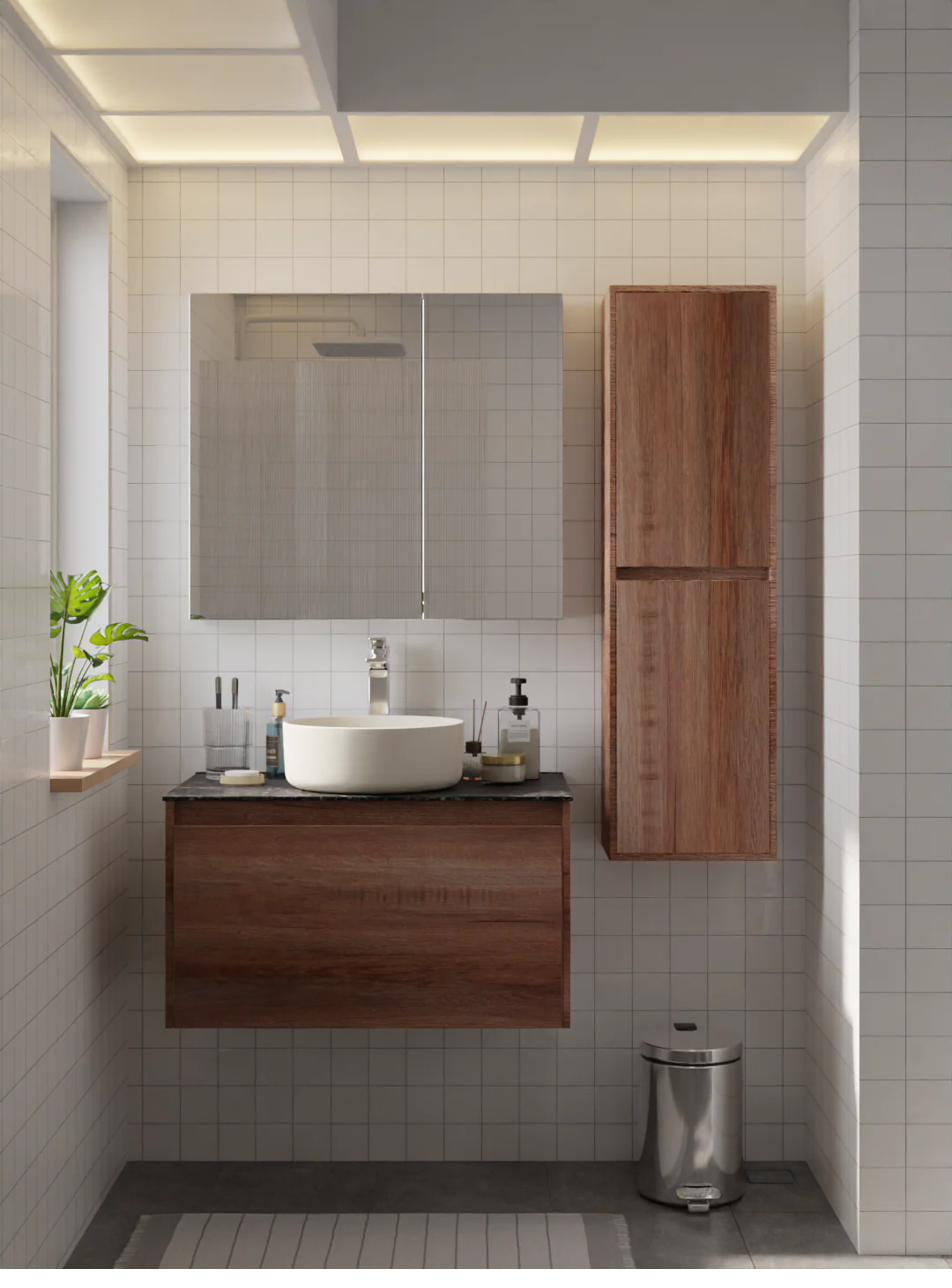
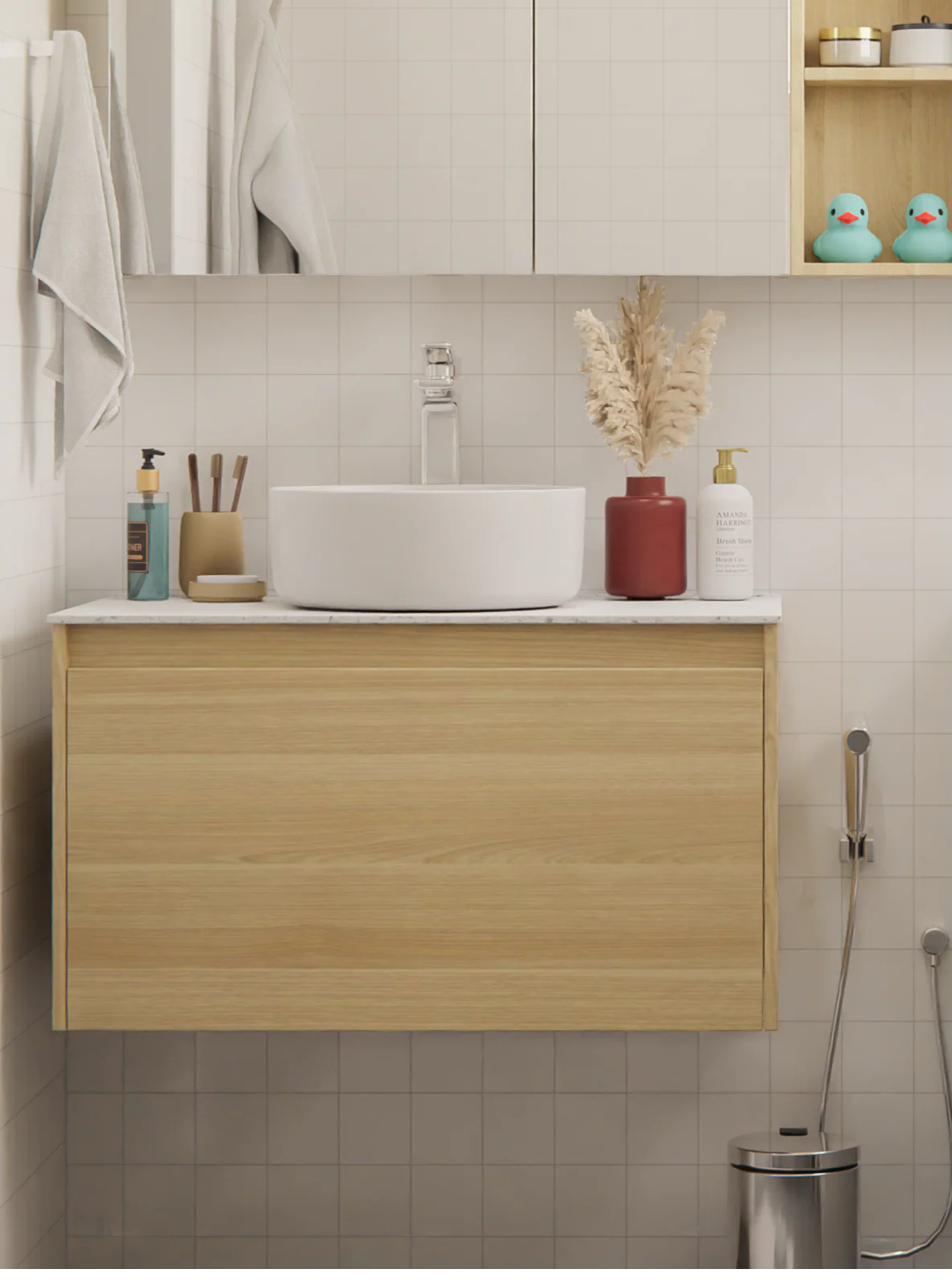
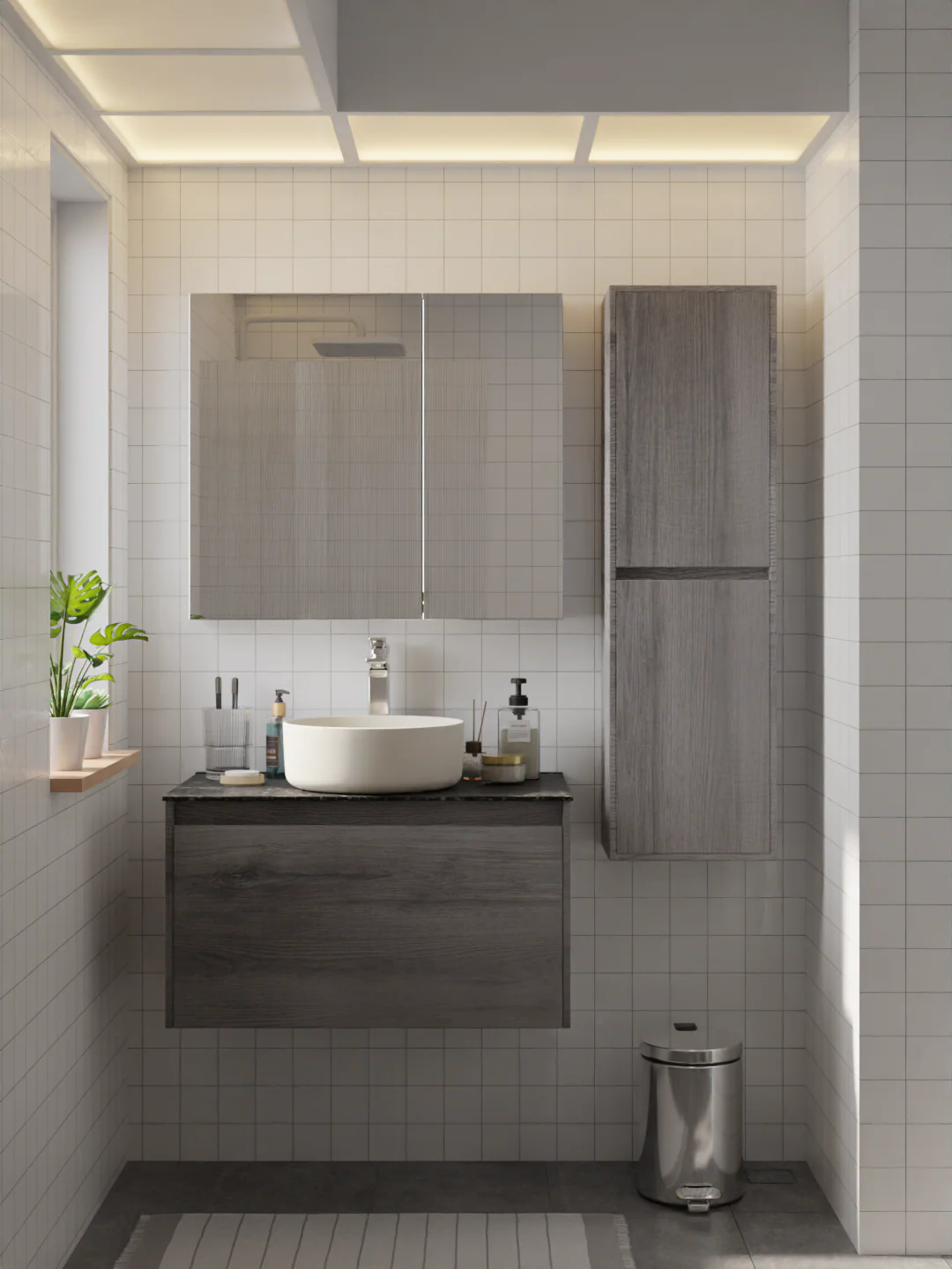
This is what we build our vanities from. The core is moisture-stable PVC. The surface comes in Ash Wood, Grey Oak and Brown Walnut, which are high-quality wood-look finishes, and in plain Slate Grey. The wood tones look like real timber. None of it warps, swells, or rots. It’s the obvious choice for our climate, and it’s the standard we wish more local renovators would adopt.
Marine-grade plywood
Genuine marine ply is engineered for prolonged wet exposure. Used carefully (with all edges sealed and no exposed end-grain), it can perform well in bathrooms. The catch is that “marine ply” is a label often loosely applied; verify the source and grade with your contractor before paying for it.
Engineered laminates and HMR boards
High-moisture-resistant boards are an upgrade on standard MDF but still a compromise. They tolerate humidity better than solid wood but will fail at any unsealed edge. Acceptable for upper cabinets and dry-zone shelving; risky for the base of a vanity.
What to avoid
Standard MDF, particle board, untreated solid hardwood. All three will absorb moisture from the air alone, regardless of whether they ever get directly splashed.
Metal hardware and rust resistance
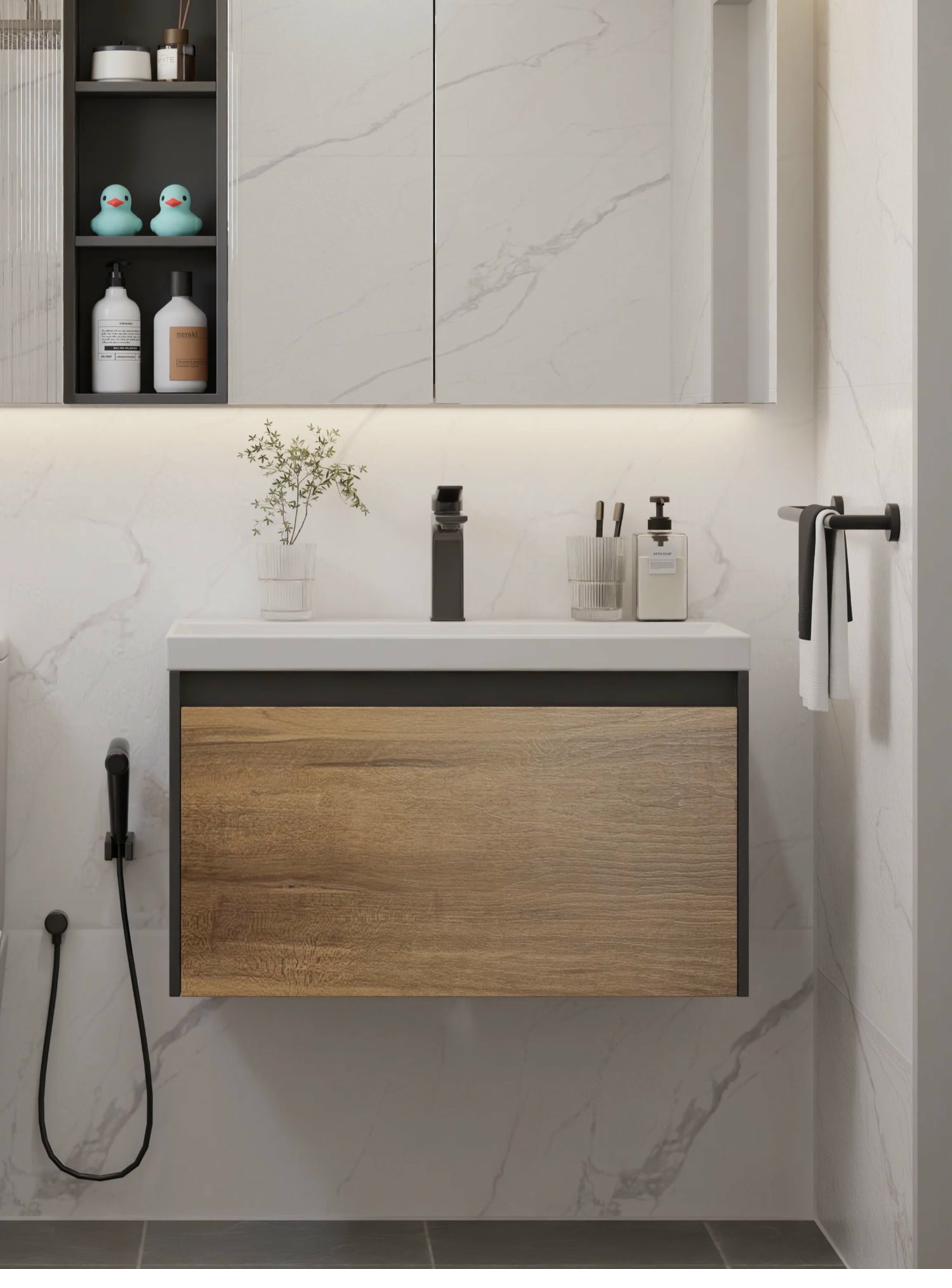
Hinges, drawer slides, knobs, robe hooks, towel bars. The hardware is the part of the bathroom that fails first if it’s wrong, and it’s often the cheapest part of the spec sheet, which is exactly why contractors cut corners here.
What survives our climate:
- 304 or 316 stainless steel, the gold standard. 316 is preferred for any item that’s splashed regularly (taps, drains, robe hooks near the shower). 304 is fine for items further from direct water.
- Solid brass with a quality plated finish, brass is naturally corrosion-resistant; the failure mode is the plating wearing through, not the underlying metal rusting.
- Aluminium, light, won’t rust, but can corrode and pit if the anodised coating is damaged.
What to avoid: zinc-alloy hinges (look fine for two years, then start blooming with white oxide), chrome-plated steel (rusts the moment the chrome wears through), painted ferrous metal of any kind.
Drawer slides deserve special mention. The cheapest slides use unprotected steel ball bearings; the bearings rust, the drawer starts to bind, and within five years the drawer doesn’t open smoothly. Specify stainless or fully-zinc-coated slides. The cost difference is small. The longevity difference is enormous.
Stone and ceramic: pros, cons, and the grout problem
For floors and walls, ceramic and porcelain tiles are still the dominant choice for good reason, they’re inert, water-tolerant, and durable. The failure point is rarely the tile itself. It’s the grout between the tiles.
Tile selection
Porcelain beats ceramic for water absorption. Look for a water-absorption rating below 0.5% if you want a tile that doesn’t darken when wet. Large-format tiles reduce total grout length, which is the single biggest move you can make for low-maintenance walls.
Grout
Standard cement grout absorbs moisture and stains. Within a year or two it goes grey or develops black mould lines. The fix is one of two upgrades:
- Epoxy grout. Waterproof, stain-resistant, lasts a decade or more without re-sealing. Costs more upfront and is harder to apply, insist on a contractor who has actually done it before.
- Sealed cement grout. Standard grout with a penetrating sealant applied annually. Cheaper, but you’re committing to the maintenance schedule.
Natural stone
Marble, travertine, and natural stone vanities look wonderful for the first two years. Then the staining starts. Cosmetics, hair dye, even hard-water mineral deposits can permanently mark soft stone surfaces. If you want stone, choose a sealed quartz composite instead, the look without the staining vulnerability.
Paint and wall finishes
Standard interior emulsion is the wrong paint for a bathroom, it absorbs moisture, mould grows in the absorbed water, and within a year you have a fuzzy ceiling.
What to specify:
- Bathroom-grade acrylic paint with anti-mould additives. Look for products explicitly rated for kitchen and bathroom use.
- Satin or semi-gloss finish rather than matte. Matte paint is more porous; satin and gloss shed water and wipe clean.
- Silicate or mineral paints, an excellent if more expensive option that allows walls to breathe and resists mould without chemical additives.
If you have a ceiling that’s prone to dripping condensation, that’s your extractor or ventilation telling you it can’t keep up. Paint is a symptom, not a cause, fix the airflow.
Sealants and joint silicone
Silicone is the unglamorous material that’s doing the most work in your bathroom. It seals the tub-to-wall joint, the basin-to-counter joint, and dozens of small gaps in between. When silicone fails, water gets behind the wall. From there it’s a slow, expensive problem.
Cheap silicone yellows within a year, peels within three, and harbours mould throughout. Quality silicone (specifically anti-mould sanitary silicone, neutral cure) lasts five to seven years before it needs replacing.
Silicone joints are consumables. If your bathroom is more than five years old and the silicone is yellowing or pulling away, scrape it out, clean the surfaces, and re-apply with quality anti-mould product. A few hours of work prevents thousands of dollars of waterproofing damage.
Maintenance habits that double material lifespan
Specification matters most. But even the right materials will fail twice as fast if maintenance is poor. The habits that genuinely move the needle:
- Run the extractor for 15 minutes after every shower. Most extractors can be wired to a timer for under a hundred dollars. Worth it.
- Squeegee glass surfaces after showers. Sounds fussy. Takes ten seconds. Eliminates ninety percent of glass-cleaning effort over the lifetime of the bathroom.
- Wipe wet horizontal surfaces dry. Vanity countertops, tap bases, the lip of the basin. A microfibre cloth and ten seconds prevents the slow water damage that dulls finishes.
- Don’t use abrasive cleaners on PVC, lacquered wood, or matte-finish surfaces. The finish is what protects the substrate. Once it’s scrubbed off, you’re exposing the vulnerable layer underneath.
- Replace silicone joints every five to seven years. Treat it like changing the oil, not optional, just routine.
What we actually use at HERA, and why
Our vanity range is built around waterproof PVC cores with high-quality wood-effect finishes precisely because we’ve seen what happens to solid wood and MDF in Singapore bathrooms. Our hinges and drawer slides are specced for humid conditions, not borrowed from kitchen cabinet supply chains. Our finishes are tested against soap, makeup, and the daily wear of an actual bathroom, not an air-conditioned showroom.
None of this is exotic. The materials exist. The supply chain is mature. They cost a little more than the cheapest option, and they last several times longer. The math is straightforward, and the ten-year experience of the bathroom is dramatically different.
If you’re planning a renovation and want to know what to spec, not just for our products but for the whole bathroom, come down. We’re happy to talk through it whether or not you buy from us. We’d rather you renovate once and well than re-do it in six years.
For background on the founder’s fourteen years in the Singapore bathroom industry and why we built HERA the way we did, see our story. To see the full vanity range with the materials called out, browse here.