Most small Singapore bathrooms feel cluttered not because they have too much stuff, but because the storage was an afterthought. The vanity arrived first, and everything else, toothbrushes, lotions, towels, the spare toilet roll, got distributed across whatever flat surface was nearest. There’s a better way, and it doesn’t require a bigger room.
Why small bathrooms feel cluttered
The problem in a 4 to 6 sqm bathroom isn’t volume. A typical household’s bathroom items take up surprisingly little cubic space. The problem is that those items are spread across the wrong surfaces, sitting on the vanity countertop instead of behind a cabinet door, perched on the toilet cistern instead of stowed in a side cabinet, stacked on the floor under the sink because nothing else fits.
The fix is not minimalism. It’s designed storage. When every item has a defined home, the room reads as calm even if you own exactly the same number of bottles you did before.
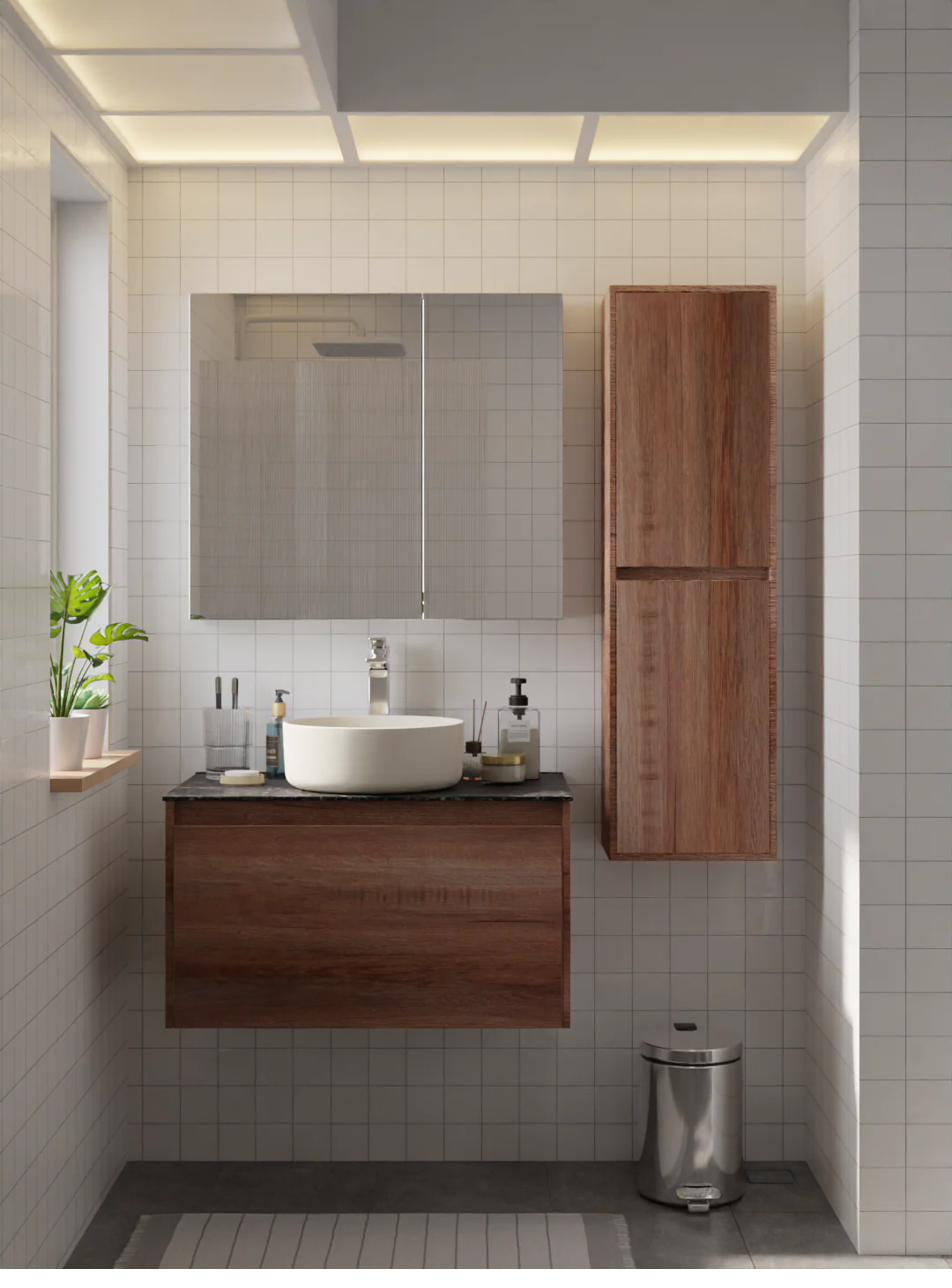
The three pieces that do most of the work in a small bathroom are the vanity (with the right format), the mirror cabinet (the most under-used storage element in Singapore homes), and a side cabinet for the things the vanity can’t hold. Get those right and the room transforms.
Wall-hung vs floor-standing vanities
If you remember nothing else from this post, remember this: in a small bathroom, wall-hung beats floor-standing almost every time.
Why wall-hung wins
- Visual lightness. Seeing 10 to 15 cm of floor under the cabinet makes the whole room feel larger. The eye reads continuous floor space as “more room.”
- Cleaning. No edge to mop around. No corner where hair and dust collect. You sweep underneath in seconds.
- Flood resilience. If a pipe leaks or your floor traps overflow during cleaning, a wall-hung cabinet stays dry. A floor-standing one absorbs water through its base and starts to rot.
- Mounting flexibility. You set the height. People above 1.8 m can mount their vanity higher and stop hunching every morning.
When floor-standing makes sense
Two cases. First, if your wall isn’t structurally suitable for hanging the weight, rare in newer HDBs but possible in some older flats with hollow partitions. Second, if the design language of your bathroom is intentionally traditional and a floor-standing piece is part of that aesthetic. Outside those cases, wall-hung is the default.
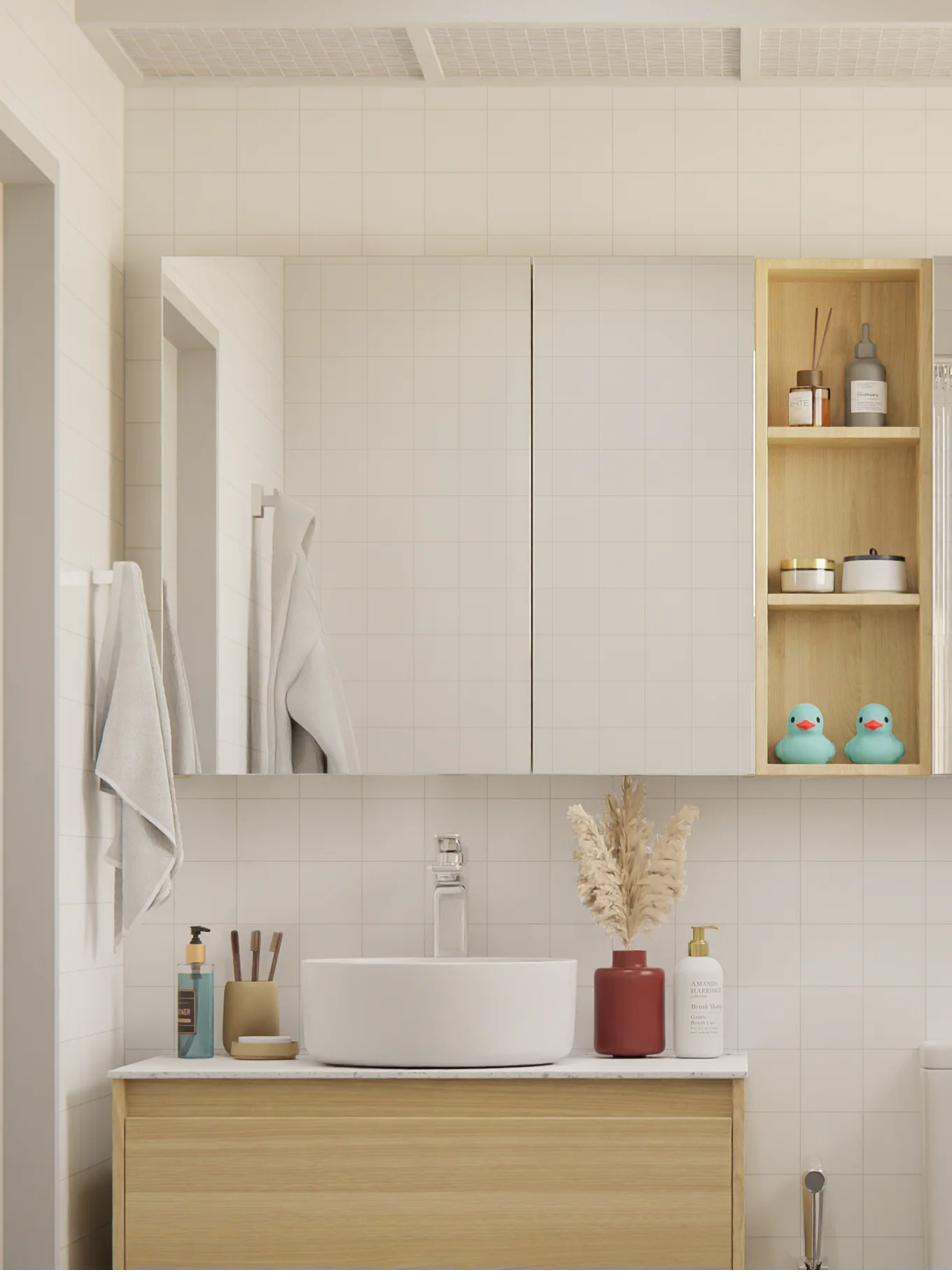
Mirror cabinets: the underrated win
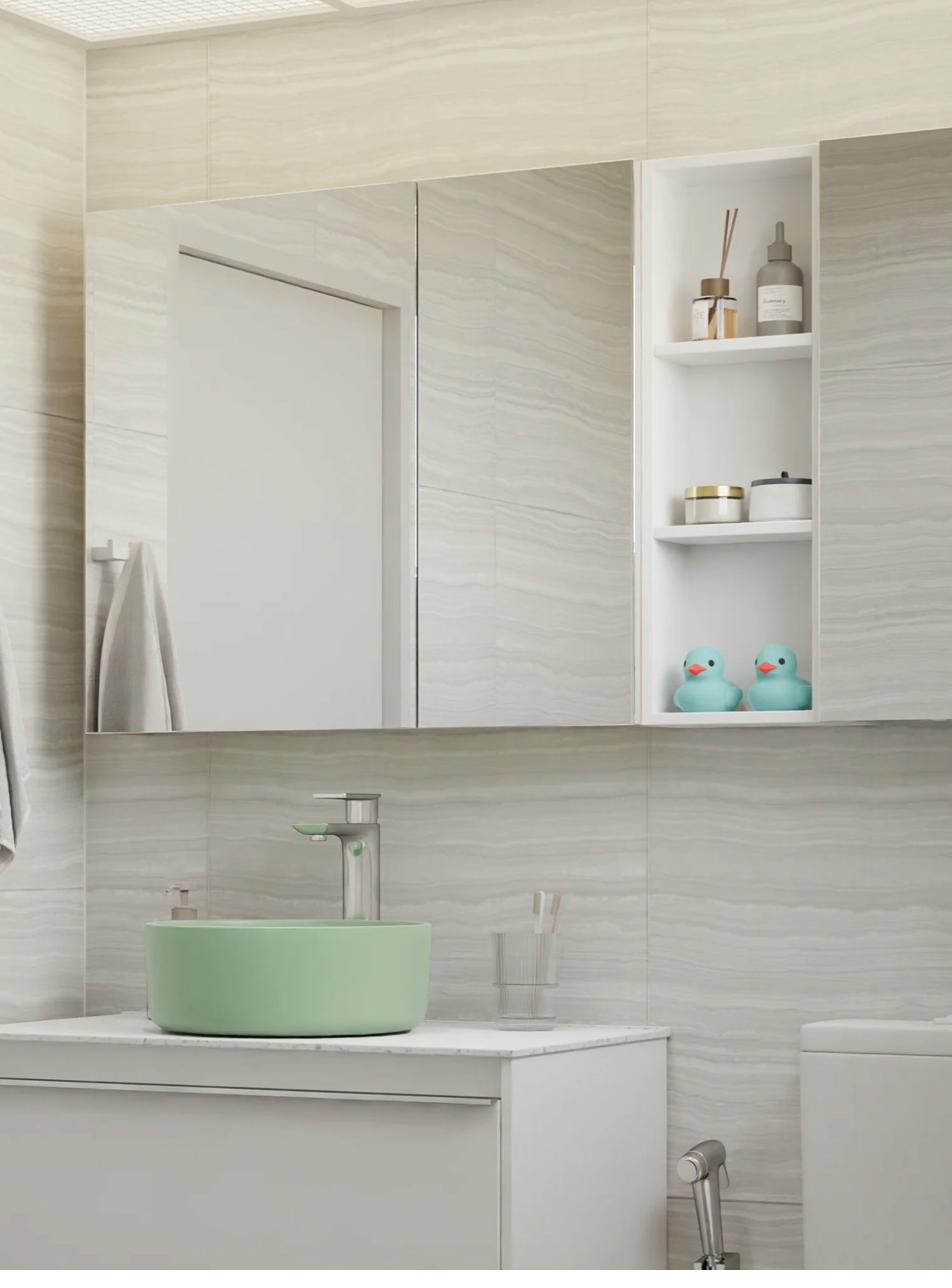
Most Singapore bathrooms have a mirror over the sink. Almost none of them have a mirror cabinet. That’s leaving the easiest storage upgrade in the entire room on the table.
A mirror cabinet does three things at once:
- It’s a mirror, same as what you already have.
- It’s about 17 cm of cabinet depth, hidden behind the mirror surface, available for daily-use items like toothbrushes, contact lens solution, makeup, deodorant.
- It moves clutter off your countertop. The vanity surface stays clear, which is the single biggest contributor to a bathroom feeling spacious.
A standard mirror cabinet over the sink can hold most of what currently sits on top of your vanity. The countertop becomes a place for hand soap and a small plant, instead of a graveyard of half-empty bottles.
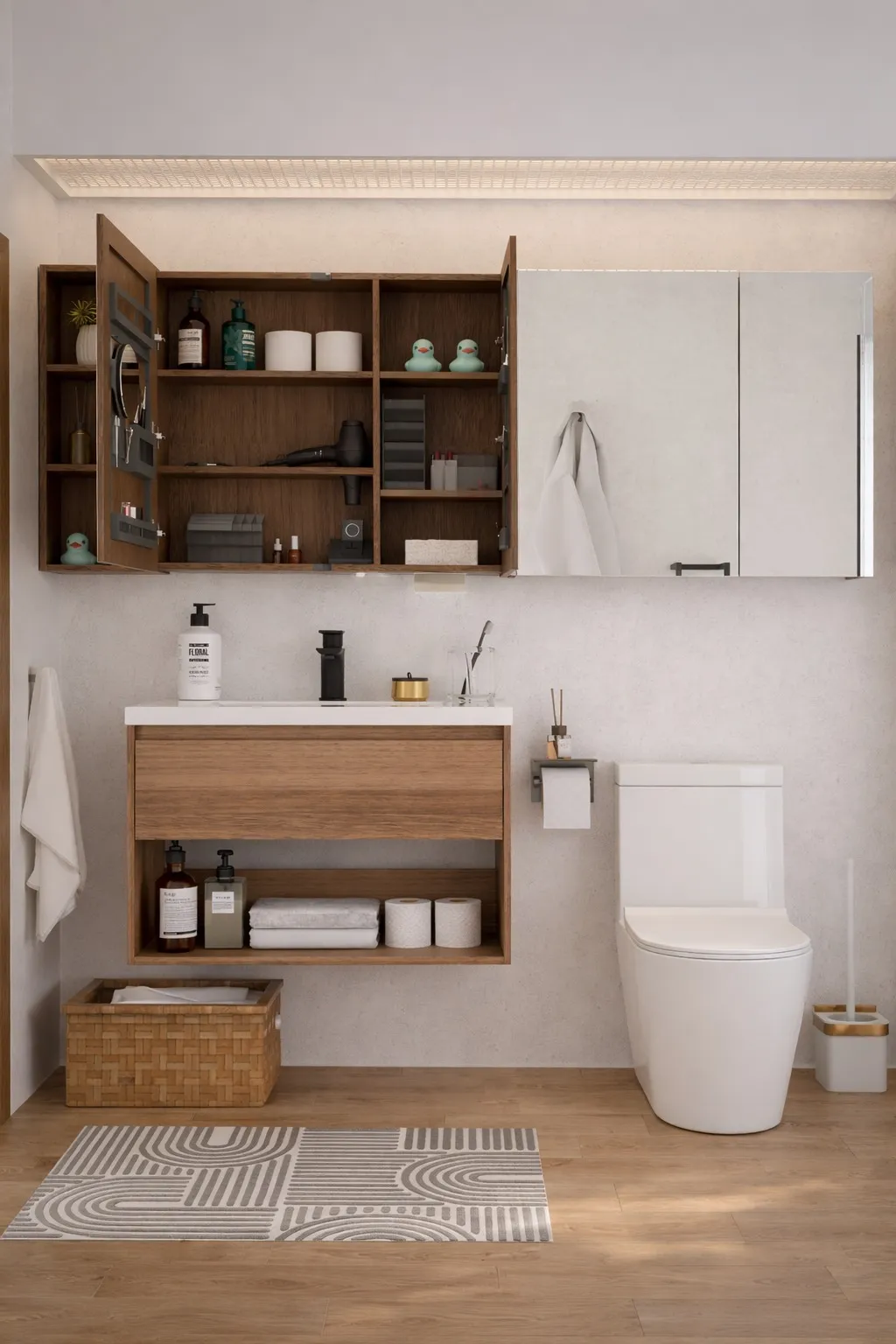
If you’re renovating and only have budget for one storage upgrade, swap your flat mirror for a mirror cabinet. Per dollar, it’s the highest-ROI change you can make to a small bathroom.
Side cabinets and the dead-corner trick
The corner of a bathroom, the bit of wall between the vanity and the toilet, or the space next to the door, is almost always wasted. A slim side cabinet (around 30 to 35 cm wide) tucks into that gap and adds an enormous amount of usable storage without taking up visual real estate.
What goes in a side cabinet:
- Spare toilet rolls (you finally stop balancing them on the cistern)
- Backup toiletries, the second bottle of shampoo, the spare toothpaste
- Cleaning supplies, in their own dedicated lower shelf
- Hairdryer, electric toothbrush, anything with a cord that currently lives on the countertop
- Towels, if you have the depth for it
The side cabinet does the unglamorous storage work. The vanity and mirror cabinet handle the daily-use items. The countertop stays clear. This is the entire small-bathroom playbook in one paragraph.
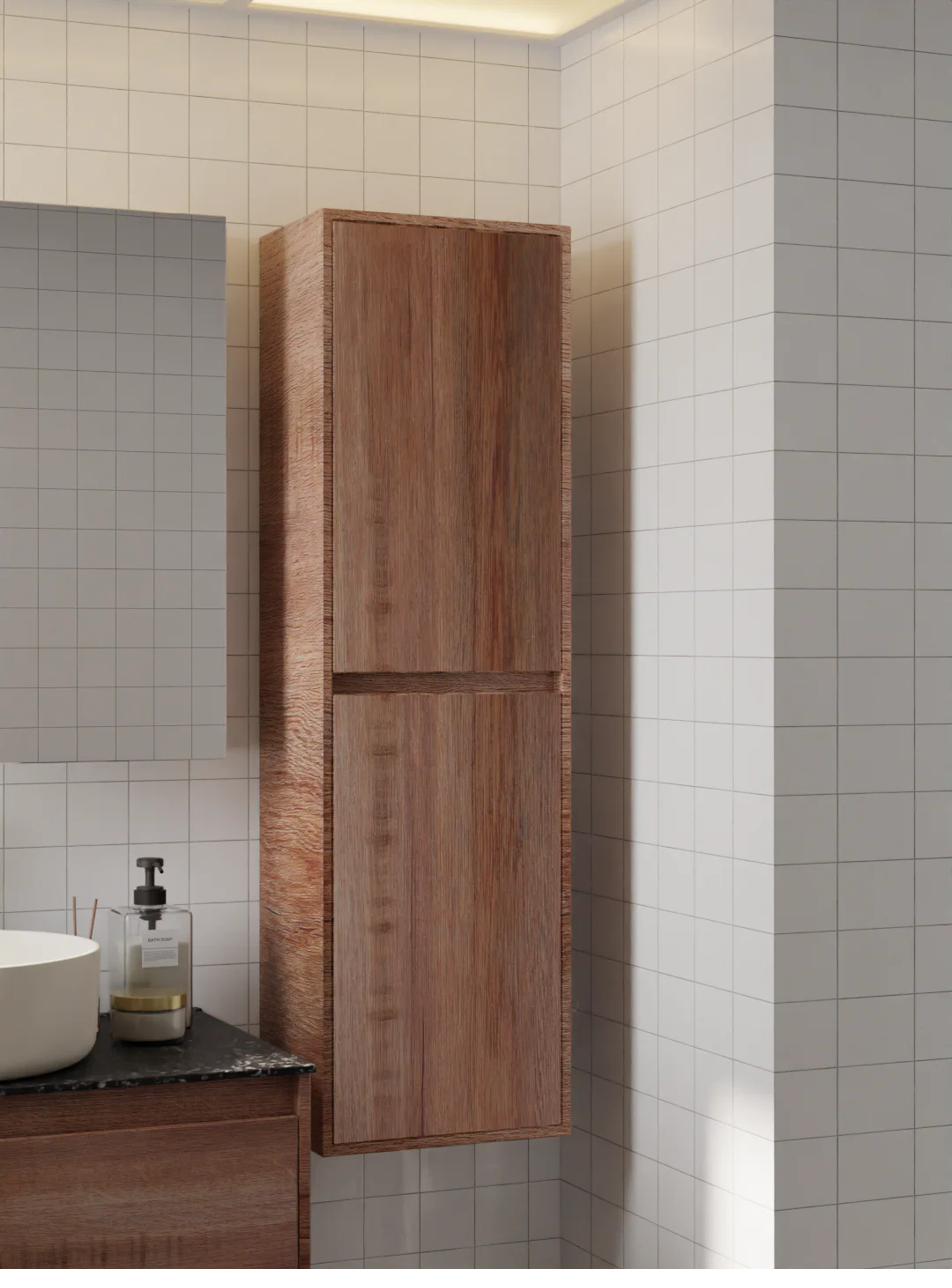
Vanity widths that actually fit HDB layouts
Picking the wrong vanity width is the single most common mistake we see. Too narrow and the basin feels cramped. Too wide and you can’t open the door fully or get past it to the toilet.
Rough sizing for typical HDB bathrooms:
- Compact (around 60 cm): Works in tight common bathrooms where every centimetre matters. Single basin, slim profile.
- Standard (around 70 to 80 cm): The default for most HDB master bathrooms. Single basin with usable counter on either side.
- Wide single basin (around 90 to 100 cm): Generous counter space without the complexity of a double sink. Wider than anything in the current HERA range, which tops out at 80 cm.
- Double basin (around 120 cm and up): Possible in larger condo and landed bathrooms. Rarely sensible in an HDB, the floor space is better used elsewhere.
Take the longest unobstructed wall, subtract clearance for the door swing, and that’s your maximum vanity width. Pick a unit that’s 10 to 15 cm short of that maximum, not the largest one that physically fits.
Colour choices that make small bathrooms feel bigger
The right finish does almost as much for perceived size as the right layout. A few principles we apply when specifying for small spaces:
Light, warm wood tones
Ash Wood, Grey Oak, White. They reflect light, they’re neutral enough to live with for a decade, and they hide water marks better than dark wood. If you want one rule for small bathrooms, this is it.
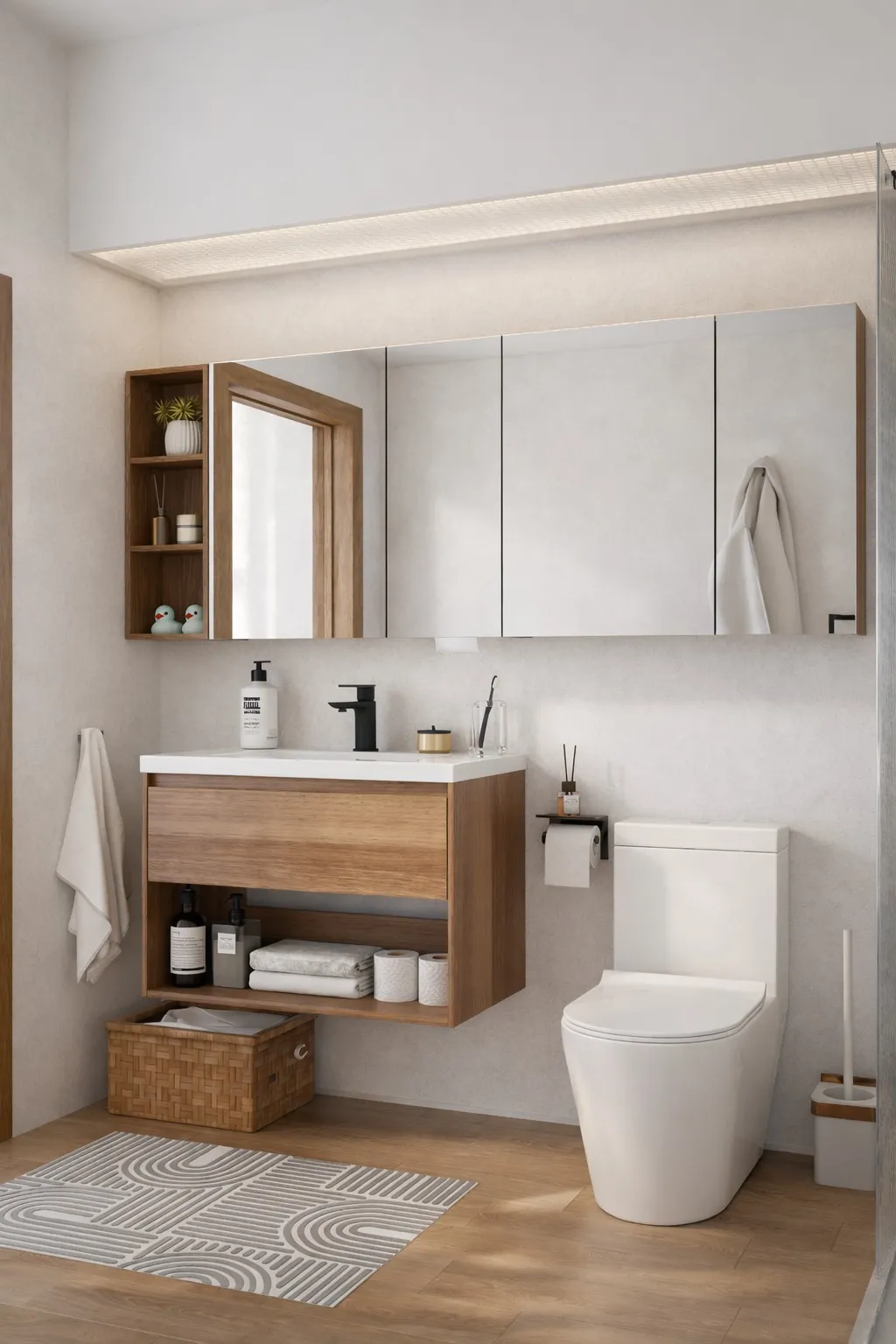
Dark accents in moderation
Brown Walnut and other dark finishes look stunning in renderings and magazine spreads. In a small bathroom, they shrink the room visually. Use them as accents (a side cabinet, the mirror frame) rather than the dominant tone.
Match the wall colour
If your walls are warm white, a warm white or off-white vanity will visually merge with the wall and read as “less stuff.” If you want the vanity to be a feature, contrast the wall colour. Don’t do both at random, that’s where bathrooms start to look chaotic.
Common storage mistakes we see every week
- Open shelving in a humid bathroom. Looks great. Collects dust and water marks within a month. Closed cabinets win in Singapore’s climate, every time.
- Drawers without internal organisers. A 60 cm drawer with no dividers turns into a junk drawer. Spend the small extra on dividers.
- Cabinets that block the toilet roll holder. Sounds obvious, but we see it constantly. Plan the door swing in 3D, not just in plan view.
- Choosing finish before measuring. The walnut you fell in love with in the showroom only comes in an 80 cm width. Your wall is 78 cm. Measure first, fall in love second.
- Forgetting where the plug points are. Hairdryers and electric toothbrushes need a socket. The most frustrating storage in the world is a beautifully organised cabinet whose contents have to be unplugged from across the room.
Putting it all together
The small-bathroom storage formula isn’t complicated:
- Wall-hung vanity, sized one bracket smaller than the maximum that fits.
- Mirror cabinet above it, not a flat mirror.
- Slim side cabinet in the dead corner.
- Light, warm finish for the dominant pieces; darker accents only if the room can take it.
- Closed storage everywhere. Save open shelving for the bedroom.
Apply those five and almost any bathroom under 6 sqm will feel calmer, larger, and more lived-in. Skip any of them and you’ll spend the next ten years thinking your bathroom is “too small,” when really it’s just badly storage-planned.
If you’d like to see the formats up close, our showroom has wall-hung vanities, mirror cabinets, and side cabinets on display in real bathroom-sized rooms, not warehouse displays. Browse the vanity range here first, then come down and open the drawers.